Table Of Content
The six treatment combinations can still be accommodated when blocking by litter, and using four litters of size six results in the experimental layout shown in Figure 7.7 with 24 mice in total. Already including a medium-fat diet would require atypical litter sizes of nine mice, however. Thus, in any experiment that uses blocking it’s also important to randomly assign individuals to treatments to control for the effects of any potential lurking variables.
Up is Down: Mid-Century Experiments in Advertising and Film at the Goldsholl Studio Review – Fascinating and ... - Splash Magazines
Up is Down: Mid-Century Experiments in Advertising and Film at the Goldsholl Studio Review – Fascinating and ....
Posted: Tue, 02 Oct 2018 07:00:00 GMT [source]
4.2 Nesting Blocks
In an RCBD, we can estimate any treatment contrast and all effects independently within each block, and then average over blocks. We can use the same intra-block analysis for a BIBD by estimating contrasts and effects based on those blocks that contain sufficient information and averaging over these blocks. Deciphering the association between sample characteristics, e.g.,tumor types, and the proteome holds the key for improved diagnosticand treatment of diseases.
Allocate you observations into blocks
Whenever, you have more than one blocking factor a Latin square design will allow you to remove the variation for these two sources from the error variation. So, consider we had a plot of land, we might have blocked it in columns and rows, i.e. each row is a level of the row factor, and each column is a level of the column factor. We can remove the variation from our measured response in both directions if we consider both rows and columns as factors in our design. If the structure were a completely randomized experiment (CRD) that we discussed in lesson 3, we would assign the tips to a random piece of metal for each test. In this case, the test specimens would be considered a source of nuisance variability. If we conduct this as a blocked experiment, we would assign all four tips to the same test specimen, randomly assigned to be tested on a different location on the specimen.
3 - The Latin Square Design
We could select the first three columns - let's see if this will work. Click the animation below to see whether using the first three columns would give us combinations of treatments where treatment pairs are not repeated. Is the period effect in the first square the same as the period effect in the second square? If it only means order and all the cows start lactating at the same time it might mean the same.
If different processing steps of the protocol have differentsizeconstraints, i.e., one step requires more batches than another, beingable to combine the smaller batches into larger batches without havingto split the smaller batches is ideal. For example, when one experimentalstep can process 12 samples at once, while another step can process24 samples at once, two batches from the first step can be combinedfor the second processing step. When this is not possible, it makesmost sense to set up the batches according to the smallest constraints,and keep these batches throughout. In the following wewill assume the conceptually simplest settingof label-free quantification without the use of reference samples.The concepts and considerations are however generally independentof the experimental setup.
Or do blocks 3 and 4 have a higher mean because they contain both compounds 3 and 4? The design cannot help us entirely disentangle the impact of blocks and treatments19. In our modelling, we will assume variation should first be described by blocks (which are generally fixed aspects of the experiment) and then treatments (which are more directly under the experimenter’s control). Here, each block has size 4, which is equal to the number of treatments in the experiment, and each treatment is applied in each block. The design is balanced having the effect that our usual estimators andsums of squares are “working.” In R, we would use the model formulay ~ Block1 + Block2 + Treat. We cannot fit a more complex model, includinginteraction effects, here because we do not have the corresponding replicates.
If we want to analyze data from an RCBD, we need to assume that the block-by-treatment interaction is negligible. We can then merge the interaction and residual factors and use the sum of their variation for estimating the residual variance (Fig. 7.2D). Latin Square Designs are probably not used as much as they should be - they are very efficient designs. In other words, these designs are used to simultaneously control (or eliminate) two sources of nuisance variability. For instance, if you had a plot of land the fertility of this land might change in both directions, North -- South and East -- West due to soil or moisture gradients.

3 Analysis of variance
Depending on the nature of the experiment, it’s also possible to use several blocking factors at once. However, in practice only one or two are typically used since more blocking factors requires larger sample sizes to derive significant results. Gender is a common nuisance variable to use as a blocking factor in experiments since males and females tend to respond differently to a wide variety of treatments. In case all samples cannot be processed together, one first createsthe batches, and subsequently performs block randomization withineach batch. Given that we are interested in all comparisons betweenthe treatment–sex combinations, we make two batches of 12 samples,each batch containing three subjects of each group (Figure Figure55). This way, the batches arebalanced in terms of the subject-characteristics that we use in theanalytical model.
Chapter 7 Improving Precision and Power: Blocked Designs
For that reason, we will start off our discussion of blocking by focusing on the main goal of blocking and leave the specific implementation details for later. In this article we tell you everything you need to know about blocking in experimental design. After that, we discuss when you should use blocking in your experimental design. Finally, we walk through the steps that you need to take in order to implement blocking in your own experimental design. In this case treatment (1) and treatment ab will be in the first block, and treatment a and treatment b will be in the second block. Blocking designs are also important in animal experiments (Lazic and Essioux 2013; Festing 2014), and replicating pre-clinical experiments in at least two laboratories can greatly increase reproducibility (Karp 2018).
When the experiment consists of multiple batches,they will undergothe same experimental protocol at different points in time and/orspace. Every step of the protocol may then introduce variation thatis specific for each batch. If samples are moved across batches betweenprocessing steps, each processing step has its own specific sample-to-batchallocation. Then, each processing step will have its own batch effect,and each of these will have to be estimated, unnecessarily increasingthe complexity of the model.
Design of protein-binding proteins from the target structure alone - Nature.com
Design of protein-binding proteins from the target structure alone.
Posted: Thu, 24 Mar 2022 07:00:00 GMT [source]
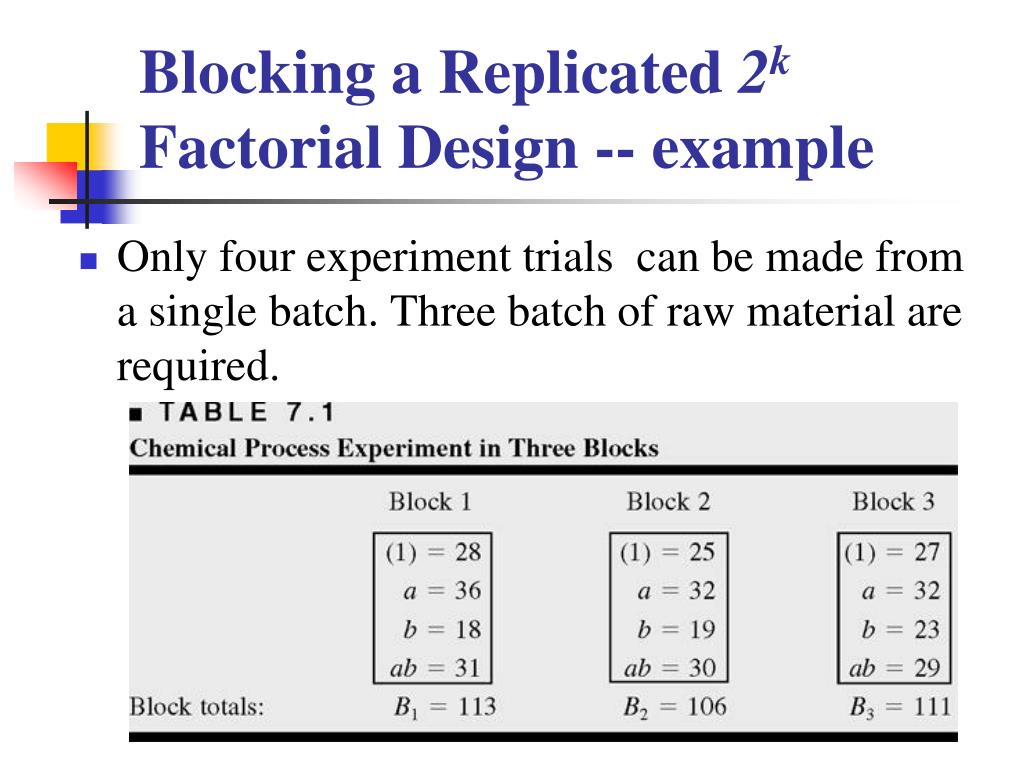
As the 2k design is primarily used to screen factors/variables, often a very large number of experimental units are required to complete even one full replication. For an example, 26 design with six variables requires 64 experimental units to complete one full replication. In the 2k design of experiment, blocking technique is used when enough homogenous experimental units are not available.
When the groups do not have a small common divisor, one can createblocks of different sizes. For example, in a nine vs ten setting,one would make eight blocks consisting of one subject of each group,and one block with the remaining three subjects (Figure Figure33B). In an experiment with multipletreatment levels, e.g., Placebo, Treatment1, and Treatment 2, the blocks would consistof subjects from all treatments. As previously, the blocks are putin random order, the order of the treatments within the blocks ischosen randomly for each block, and subjects are finally randomlyallocated according to their characteristics. A nuisance factor is a factor that has some effect on the response, but is of no interest to the experimenter; however, the variability it transmits to the response needs to be minimized or explained.




No comments:
Post a Comment